Orders, inventory and deliveries · 4 min read
From order to delivery, in one system
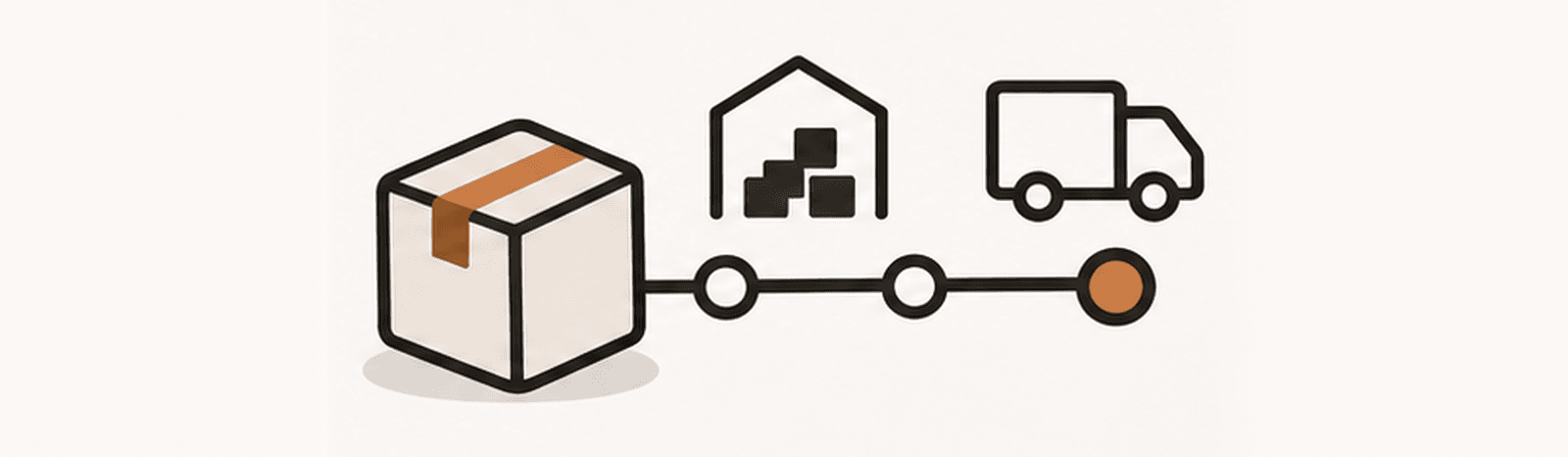
An order passes through several hands: whoever takes it, whoever fills it, whoever delivers it and whoever collects payment. When each of them uses their own tool (a chat, a notebook, a sheet), the order is written again at every step, and that is where it gets lost.
An orders and inventory system keeps a single record from start to finish and keeps the stock up to date with every movement. These are the six questions it must be able to answer at any time.
01What was ordered, and through which channel?
Today: orders arrive by WhatsApp, by phone and at the counter. One gets forgotten or filled twice.
With a system: every order is recorded once, when it arrives, by hand or straight from the connected channels. That record is the same one for everyone who touches it.
02Do we have it?
Today: the sheet says twelve and the shelf has four. And even if the number were right, it does not say how many of those pieces are already committed. You promise what you do not have.
With a system: three numbers that are often confused are kept apart: what is physically there, what is already set aside for confirmed orders and what can really be sold. Every recorded entry, exit, sale, return and adjustment updates them on the spot.
03Which stage is it in?
Today: the customer asks about their order and someone has to call the warehouse and the driver.
With a system: every order has a visible stage: received, filled, on the way, delivered. Anyone can look it up, and the customer can get the notice without anyone sending it.
04Was it delivered?
Today: the order goes out and the only proof is the word of whoever took it. If only part of it was delivered or the customer rejected something, nobody writes it down.
With a system: whoever delivers marks from their phone what was delivered, what was returned and what was left pending, with the proof you define: a signature, a photo or the name of whoever received it. A partial delivery leaves the rest of the order open, and what is returned or rejected goes back into stock or is recorded as a loss.
05What needs to be bought?
Today: you find out something ran out when a customer asks for it.
With a system: every product has a minimum, and the system flags it before it is reached. Purchases are decided with numbers.
06What sells and what sits?
Today: the data exists, but scattered across sheets nobody has the time to put together.
With a system: you see which products move, which have been sitting for months, which customers buy the most and at which stage orders get stuck.
Why a spreadsheet is not enough
With few orders a day and one person, a sheet is enough. It stops being enough when several people take, fill and deliver orders. A sheet stores the number someone typed in last time. A system updates the stock with every recorded movement, without entering it twice: it subtracts on a sale, adds on a receipt, flags what is running low and keeps a record of every delivery. Orders, stock and deliveries stop being three lists and become a single operation.
Three things you can check this week
- 01Can you say, without going to count, how many pieces of your best-selling product can be sold today?
- 02Do you know which stage each of this week’s orders is in without asking anyone?
- 03Can you check what happened with the last delivery a customer complained about?
The ones you cannot answer are the best place to start.
Where to start
You do not need to count the whole inventory or change everything overnight. You start by recording orders in one place and with your fastest-moving products; the rest is added in parts. If you already take orders by WhatsApp or on your site, they are not replaced: they are integrated.
If you want to know how organized your operation is, assess it in nine questions. If you would rather talk it through, book a 15-minute call.
Free, no commitment.